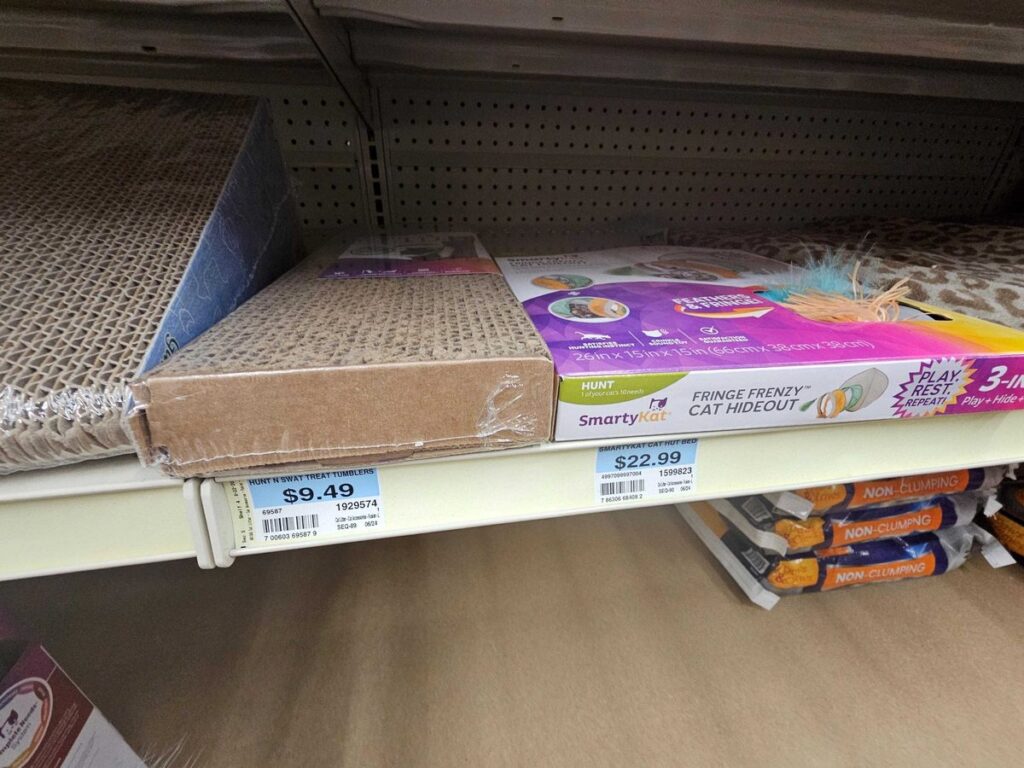
TJX Companies and HomeGoods is a value-tier channel built for deals — pet suppliers with excess inventory or sharp price points can move volume that would stall in a conventional supermarket.
TJX Companies and HomeGoods: A Variety-Value Channel
- Founded: TJX traces its origins to 1976, when Bernard Cammarata launched the concept that opened the first two T.J. Maxx stores in 1977. The TJX Companies, Inc. was formed in 1987. HomeGoods was launched later as the group’s dedicated off-price home banner.
- Founder: Bernard Cammarata, widely regarded as the architect of modern American off-price retailing.
- Headquarters: 770 Cochituate Road, Framingham, Massachusetts, United States.
- Ownership: Publicly listed on the New York Stock Exchange under the ticker TJX. Leadership comprises Ernie Herrman as Chief Executive Officer and President (CEO since January 2016), with Carol Meyrowitz as Executive Chairman.
- Scale and revenue: Group net sales for fiscal 2026, the 52 weeks ended 31 January 2026, reached USD 60.37 billion, up 7 percent year on year and the first time the group has passed USD 60 billion. Net income was USD 5.49 billion with diluted earnings per share of USD 4.87.
- HomeGoods segment: The HomeGoods segment in the United States generated approximately USD 10.17 billion of net sales in fiscal 2026, roughly 16.9 percent of group revenue, with a segment profit margin of 12.2 percent.
- Stores: TJX ended fiscal 2026 with 5,214 stores across ten countries and 136.3 million gross square feet, having added 129 net new stores in the year. Within that estate, HomeGoods operated 963 stores in the United States and Homesense a further 79, for a combined 1,042 doors. The company’s stated long-term potential for HomeGoods including Homesense US is 1,800 stores, against a total group potential of 7,000.
- Workforce: Approximately 377,000 associates as of 31 January 2026, of whom around 86 percent work in retail stores.
- Financial strength: Fiscal 2026 operating cash flow of USD 6.9 billion, year-end cash of USD 6.2 billion, USD 4.3 billion returned to shareholders, and an S&P Global “A” rating that TJX explicitly describes as important to its vendors and landlords.
Treasure-Hunt Assortment
TJX does not buy the way a conventional retailer buys. Instead of committing to seasonal programmes many months ahead, its buying organisation operates in the market continuously, taking advantage of manufacturer overproduction, cancelled orders, packaging changeovers, closeouts and end-of-season inventory. Buyers are empowered to move quickly on a defined quantity at a defined price, which means decisions can be made in days rather than quarters. The trade-off for the vendor is that TJX will rarely guarantee a repeat order for the same item.
Three consequences follow for suppliers. First, price discipline is absolute: the group’s entire proposition rests on offering merchandise at a meaningful discount to department and specialty store prices, so the negotiated cost must already contain the margin. Second, inventory turns fast and stores receive new shipments multiple times per week, which supports the “treasure hunt” experience and drives repeat visits, but also means assortments are store-specific and unpredictable. Third, because TJX avoids the deep markdown cycles that erode margin at full-price retailers, it protects profitability without asking vendors for post-season markdown support in the way a traditional department store might.
The group also runs a low-overhead store model with limited fixturing and marketing spend, and it operates a multi-banner portfolio, so goods that do not suit HomeGoods may find a home in Homesense, T.J. Maxx, Marshalls, Sierra, Winners, HomeSense Canada or TK Maxx in Europe and Australia. A single conversation can therefore open several routes to shelf.
Pet as Impulse and Adjacency
HomeGoods positions pet products as part of the home rather than as a separate specialty department, and the banner’s own consumer messaging invites shoppers to pamper their pets with treats and toys alongside cookware, bedding and decor. The assortment in stores typically spans pet beds and orthopaedic mats, feeding stations and ceramic or stoneware bowls, plush and rope toys, scratchers, collars, leads, apparel, storage for food and toys, seasonal and holiday pet items, and a selective range of treats and chews. Industry observers describe pet products as one of the banner’s growing categories.
The commercial logic is strong. Pet beds, bowls, ceramic and textile accessories and decorative pet furniture behave exactly like the rest of the HomeGoods mix: they are design-led, they carry a visible reference price, they are bought on impulse and they benefit from the discount narrative. Reported price gaps against specialty pet chains for durable goods such as orthopaedic beds, ceramic bowl sets and collars are substantial, which is precisely the value equation the format needs. Skew is heavily toward dogs, with a smaller cat presence and very limited small-animal representation, so dog-first ranges have the widest opportunity.
TJX does not run a conventional retailer private label pet brand in the way a European grocer does. Merchandise arrives under recognised brands, lesser-known labels and manufacturer house brands. For an exporter, that is an advantage: there is no requirement to win a formal private-label tender before getting product on shelf.
Closeout and Supplier Flexibility
Suppliers approaching TJX should prepare for a buying conversation that is short, specific and commercially blunt. Expect to lead with a defined available quantity, a landed cost, a comparable retail reference price and immediate or near-term availability. Vague offers of ongoing capacity are much less persuasive than a concrete, ready-to-ship parcel.
Practical requirements include compliance with US Consumer Product Safety Commission rules and, where the item is marketed for children or has crossover use, applicable CPSIA testing; California Proposition 65 warning assessment; accurate country-of-origin and fibre or material labelling; and third-party test reports from a recognised laboratory. Pet food, treats and chews sit under Food and Drug Administration oversight with state-level feed registration requirements, so shelf-life, expiry dating and label accuracy must be impeccable; off-price channels are scrutinised closely on dating, and short-dated consumable stock is a reputational risk rather than an opportunity.
Suppliers should also assume factory social-compliance auditing, packaging that survives high-touch store handling without a fixture, ticketing and barcode conformity to TJX specifications, and readiness for consolidated shipment to regional distribution centres. Minimum order quantities are not published, but the practical threshold is high: buyers work in full-container and multi-container parcels because the economics of opportunistic buying depend on volume. Payment terms in the off-price channel are typically negotiated in the 60 to 90 day range, which should be modelled into working capital planning.
Tariff exposure is now a first-order commercial variable. TJX has publicly framed its recent guidance around the assumption that prevailing United States import tariffs remain in place and has stated that it expects to offset the significant pressure it anticipates from tariffs. Suppliers who can present duty-engineering options, alternative country-of-origin capacity or transparent landed-cost modelling become materially more useful partners.
2024-2026 Store Growth
Fiscal 2026 was a landmark year. Annual sales surpassed USD 60 billion for the first time, consolidated comparable sales rose 5 percent for the full year and 5 percent in the fourth quarter, and full-year pretax profit margin reached 12.1 percent. Reported results included a USD 470 million gain from the long-running credit card interchange litigation settlement with Visa and Mastercard, alongside USD 249 million of related non-recurring expenses, part of which funded a discretionary bonus for eligible associates.
Expansion continued at pace. The group opened 129 net new stores in fiscal 2026 and reached 5,262 stores with 137.4 million gross square feet by 2 May 2026. HomeGoods grew from 943 to 963 stores in the year while Homesense US moved from 72 to 79, and Sierra expanded sharply from 117 to 145 doors. TJX also confirmed a long-term store growth target of 100 TK Maxx stores in Spain, which signals further European sourcing demand.
In February 2026 the board announced a 13 percent dividend increase to USD 0.48 per share quarterly and a buyback programme of USD 2.50 to 2.75 billion for fiscal 2027. Guidance for fiscal 2027 pointed to earnings per share of USD 4.93 to 5.02. First-quarter fiscal 2027 delivered a 6 percent comparable sales increase with all four divisions positive. The company also began deploying body-worn cameras for some store colleagues, part of a wider retail response to shrink.
The Value-Tier Pet Playbook
Treat TJX as a volume clearance and opportunity channel, not as a base-load account. Build a commercial plan in which HomeGoods absorbs surplus capacity, discontinued colourways, cancelled programmes and design-led ranges at attractive unit economics, while your core forecastable volume sits with grocery or specialty accounts. That balance protects you from the inherent unpredictability of off-price reorders.
Lead with design and perceived value. HomeGoods shoppers respond to items that look considerably more expensive than they are, so invest in materials, form and finish on beds, bowls, ceramic feeders and textile accessories rather than in complex features that the shopper cannot see on shelf. Ensure every unit is self-merchandising: it must sell itself from a plain rack with no planogram, no sales assistance and no digital content.
Prioritise dogs, then cats. Build seasonal capsules for autumn and winter holidays, since seasonal decor is a core traffic driver for the banner and pet-themed seasonal items convert well. Be cautious with consumable treats unless you can guarantee long remaining shelf life and flawless compliance documentation.
Finally, prepare a single-page offer sheet per item with photography, specification, test certification, available quantity, cost, suggested retail and comparable reference price, and be ready to respond within days. The group’s financial strength, its “A” credit rating, its 5,214-store estate and its stated pathway to 7,000 stores mean that a supplier who becomes easy to buy from can be pulled into multiple banners across ten countries from a single successful parcel. That optionality, more than any single order, is the real prize.
— Scott Zhu, Founder, GlobalPetIndex
