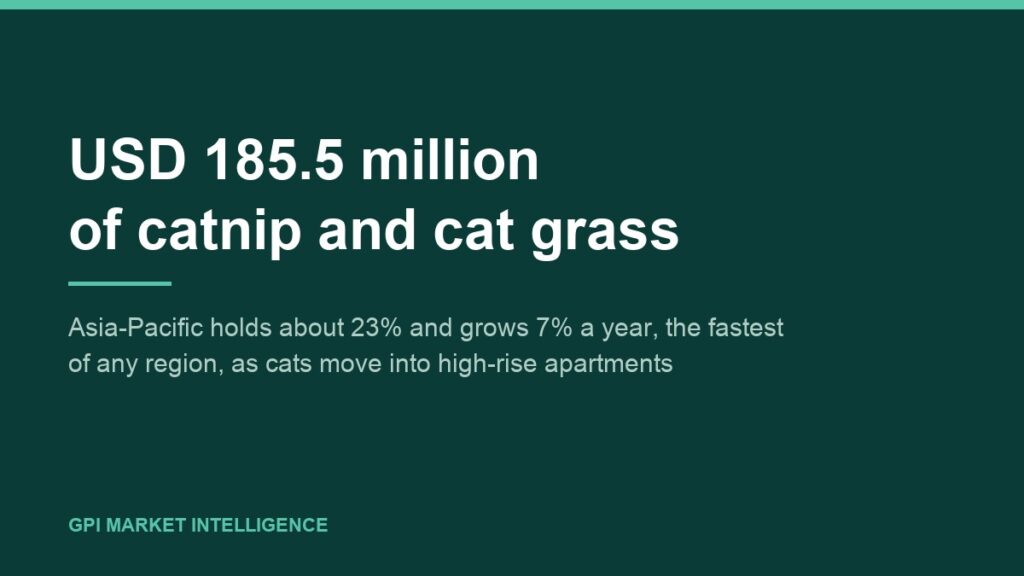
Executive Summary: Catnip and cat grass generated USD 185.5 million worldwide in 2024, and Asia-Pacific took about USD 42.6 million of that, roughly 23%, while growing at 7% a year to 2031 — the fastest rate of any region. Petfood Industry attributes the growth to high-rise apartment living across Asia, home to an estimated 400 million domestic cats, where owners buy refill seeds and hydroponic kits instead of live plants that spoil quickly.
Key Facts
- Category
- Catnip and cat grass — live plants, refill seeds, hydroponic kits, tablets, powders and silver vine
- Market size
- USD 185.5 million globally in 2024
- Asia-Pacific share
- About 23%, or roughly USD 42.6 million in 2024
- Growth
- 7% compound annual growth in Asia-Pacific through 2031, the fastest regional rate
- Driver
- High-rise apartment living and an estimated 400 million domestic cats in Asia
- Channels
- Lazada, Shopee and Temu, alongside pet specialty and grocery
- Date
- Reported 9 November 2026
- Source
- Petfood Industry, citing Cognitive Market Research and Consulting
What Happened
Petfood Industry reported on 9 November 2026 that the global catnip and cat grass market reached USD 185.5 million in 2024, with Asia-Pacific holding roughly 23% of it, or about USD 42.6 million, and expanding at 7% a year through 2031. That is the fastest regional growth rate in the category, according to Cognitive Market Research and Consulting data cited in the article.
The demand comes from a specific kind of household. Asia has an estimated 400 million domestic cats, and millions of them live in high-rise apartments where cats adapt better than dogs. Cat numbers have overtaken dog numbers in Japan, China and most Southeast Asian markets, which shifts the spending mix toward products that work indoors and in small spaces.
What sells inside those apartments is not the same as what sells in a house with a garden. Cat grass refill seeds are the fastest-moving line, while hydroponic kits outsell potted plants because they need less cleaning. Live plants give the cat something to chew immediately, but their short shelf life pushes owners into repeat purchases sooner.
Background
Cat grass is a catch-all for wheatgrass, barley grass, oat grass and rye grass, grown as a tray of seedlings and sold as a source of plant fibre. Catnip is a different product with a different mechanism: an essential oil in the leaf triggers playful or relaxed behaviour in most cats. Both have been sold for decades in garden centres and pet aisles, mostly as afterthoughts.
What changed is format. Refill seeds, kits and tablets turned a perishable plant into a stocked consumer good with a repeat cycle. In South Korea and Japan, cat grass tablets and powder supplements blend dehydrated wheatgrass fibre into a dose for hairball control and digestive support, positioned as premium wellness items rather than garden supplies. Silver vine, native to parts of China, Japan and Korea and reported to have a stronger effect than catnip, is sold on Temu, Shopee and Lazada both on its own and blended with catnip.
The botanical is hard to differentiate. Organic catnip and conventionally grown catnip come from the same plant, so the only claims a grower can defend are the growing method and the testing behind it. That is a thin moat, and it explains why listings on Lazada, Shopee and Temu compete mainly on pack size and price.
Industry Context
The supply economics are unusual for the pet sector. These are horticultural products, not manufactured ones: a grower needs seed, substrate, light and packaging, which is a low barrier to entry compared with extrusion or freeze-drying. That keeps unit costs down and margins relatively high, and it lets small regional growers enter without a factory.
It also means the category has no dominant manufacturer to set standards, price or shelf presence. Distribution sits with whoever can list the product: Lazada Singapore and Shopee Philippines for refill seeds and ready-to-use treats, Temu for silver vine and catnip blends, plus the conventional pet and grocery channels. Brand building is thin, and most listings compete on price and pack size rather than on formulation.
Market & Business Impact
The adjacent numbers are larger than the plant category itself. The global market for cat grass seeds — the refill packs sold alongside trays and kits — was put at USD 228.4 million in 2024 and is projected to reach USD 393.7 million by the end of 2033, which implies that the consumable bought again and again is worth more than the plant sold once.
For pet food makers, the interesting angle is formulation rather than horticulture. Embedding cat grass or catnip into treats and food, and selling grass tablets as digestive support, moves the product from the garden shelf into the supplement aisle, where price per unit is higher and repeat purchase is predictable. Catnip also reaches owners through catnip toys and catnip treats, so a grower with a reliable supply can sell into several product categories at once.
Companies & Brands Involved
The report names no manufacturers, which is itself a finding: the category is fragmented across growers, seed packagers and marketplace sellers rather than consolidated around brands. The channels it identifies are Lazada, Shopee and Temu. Cognitive Market Research and Consulting supplied the market sizing. GPI’s company directory lists cat product suppliers by market and category.
Data & Evidence
Global catnip and cat grass market: USD 185.5 million in 2024 (Cognitive Market Research and Consulting, cited by Petfood Industry, 9 November 2026). Asia-Pacific share: about 23%, approximately USD 42.6 million in 2024. Asia-Pacific compound annual growth: 7% through 2031, the fastest regional rate. Global cat grass seeds market (refill and kit packs): USD 228.4 million in 2024, projected to USD 393.7 million by end-2033. Asia domestic cat population: approximately 400 million. Cat numbers exceed dog numbers in Japan, China and most Southeast Asian markets.
What This Means for the Pet Industry
Catnip and cat grass are a test case for how the cat category grows in dense Asian cities: small ticket, high frequency, low manufacturing intensity. The money is in the refill and the supplement format, not the plant. Suppliers that treat these as consumables with a repeat cycle — seed packs, hydroponic refills, grass tablets — are competing in a different business from the garden centre that sells a pot once, and the growth rate reflects it.
Key Takeaways
- The global catnip and cat grass market reached USD 185.5 million in 2024, with Asia-Pacific accounting for roughly 23%, or about USD 42.6 million.
- Asia-Pacific is growing at 7% a year through 2031, the fastest of any region, driven by apartment living and an estimated 400 million domestic cats.
- Refill seeds are the fastest-selling format and hydroponic kits outsell potted plants among condo owners because they need less cleanup.
- The global cat grass refill seeds market alone was USD 228.4 million in 2024 and is projected to reach USD 393.7 million by 2033.
- The category has a low barrier to entry and no dominant manufacturer, which keeps it fragmented and price-led on marketplaces.
Frequently Asked Questions
How big is the catnip and cat grass market?
USD 185.5 million globally in 2024, of which Asia-Pacific accounted for about 23%, or roughly USD 42.6 million, according to Cognitive Market Research and Consulting data cited by Petfood Industry.
Why is Asia the fastest-growing region?
Apartment living. Asia has an estimated 400 million domestic cats, many in high-rise units where cats adapt better than dogs, and owners buy indoor-friendly formats such as refill seeds and hydroponic kits.
What is the difference between catnip and cat grass?
Cat grass is a tray of cereal seedlings — wheatgrass, barley, oat or rye — sold as plant fibre. Catnip is a herb whose essential oil triggers playful or relaxed behaviour in most cats.
Which formats sell best?
Refill seeds move fastest, hydroponic kits are preferred in apartments because they are cleaner, and tablet or powder formats sell strongly in South Korea and Japan as hairball and digestive support.
Do these products overlap with catnip toys and catnip treats?
Yes. The same botanical supply feeds catnip toys and catnip treats, and the article notes pet food with these green ingredients embedded as an adjacent route to market.
Sources
- Primary — Petfood Industry, Sale of cat grass, catnip grows in Asia’s high-rise condos, 9 November 2026, https://www.petfoodindustry.com/regions/central-western-southern-asia/blog/15836171/sale-of-cat-grass-catnip-grows-in-asias-highrise-condos
- Data — Cognitive Market Research and Consulting, catnip and cat grass market sizing cited in the article.

