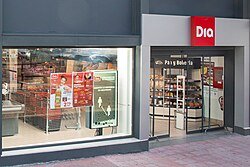
The pet aisle of a Grupo DIA store tells the whole story in a handful of SKUs: own-brand products doing the work of an entire category. That concentration is what makes Grupo DIA both demanding and lucrative for suppliers.
Grupo DIA: The Discount Profile
- Founded: 1979, in Madrid (first DIA store opened on Calle Valderrodrigo, Madrid).
- Founder: No single founder; created as a hard-discount format (originally under the Promodès group, later part of Carrefour before being spun off).
- Headquarters: Calle Jacinto Benavente 2A, 28232 Las Rozas de Madrid, Spain.
- Ownership: Public company, listed on the Spanish stock exchange (Bolsa de Madrid).
- Scale / Revenue: FY2025 group turnover of about €5.8 billion (up 3.5%); Spain net sales €4,616 million, gross sales under banner €5,565 million.
- Stores: About 2,358 stores in Spain (2025) plus around 1,007 in Argentina, for a group network of roughly 3,365 outlets, predominantly franchise-operated.
- Workforce: Around 34,000 employees (2024; about 28,500 per the 2024 annual report).
- Customers: A leading loyalty programme with about 6 million members in Spain.
- CEO: Martín Tolcachir (Group); Ricardo Álvarez (DIA Spain).
The Lean Assortment Machine
DIA is a pure-play proximity discounter: small-format stores (average about 450 m²) located within a ten-minute walk of the customer, offering a balanced assortment of high-quality private-label and leading branded products at affordable prices. The model is overwhelmingly franchise-based — around 69% of stores are franchisee-operated — which gives the chain a capital-light, rapidly expandable footprint. Central buying drives the assortment and private-label programme, while franchisees run local stores, so suppliers must win a central listing to reach the whole network.
For pet suppliers, DIA’s format favours compact, value-tier pet food, treats, litter and accessories suited to a neighbourhood top-up shop, plus a growing e-commerce platform covering about 84% of the population. The group’s 2025-2029 strategic plan explicitly targets annual gross-sales growth of 4-6% in Spain and an adjusted EBITDA margin of 7.5-8.0% by 2029, signalling disciplined but expanding private-label purchasing — ideal for cost-competitive pet suppliers.
Owned Brands and the Pet Aisle
Pet products are a natural fit for DIA’s value and private-label strategy. The chain carries dog and cat food, treats, litter and basic accessories, with a strong emphasis on its own Dia private-label pet lines that let price-sensitive shoppers trade down from national brands without abandoning quality. Given inflation-driven value-seeking, DIA’s pet private-label is a growth vector, and its neighbourhood stores generate the frequent, small-basket trips where pet treats and essentials perform well.
For exporters, the opportunity is concentrated in competitively priced own-label pet food and treats, value-tier accessories, and supplier relationships that support DIA’s margin and franchise economics. The group’s e-commerce reach (84% of population) also supports bulk or multi-buy pet formats for home delivery. Suppliers who can defend a low cost structure while meeting EU compliance and Spanish-language labelling will be well positioned as DIA executes its expansion plan.
What It Takes to Win a Grupo DIA Listing
In operational terms, DIA’s overwhelmingly franchise-based model means a central listing is essential to reach the whole network, and suppliers must therefore win the central purchasing organisation rather than individual stores. The discounter’s value positioning translates into rigorous cost and margin scrutiny, so suppliers should arrive with a defensible low cost structure and the ability to support promotional pricing without eroding product integrity. Spain applies the EU PPWR framework and national packaging-waste rules, so recyclable, eco-designed pet packaging and clear Spanish-language labelling are required, and suppliers should be ready to evidence compliance. DIA’s improving financial health — net debt of only 0.8x adjusted EBITDA and an average supplier payment period of around 41 days in 2025 — makes it a relatively secure counterparty, but the group still expects consistent national availability across more than 2,300 stores, including the franchise estate. Suppliers with Spanish market experience, competitive private-label capability and the logistics to serve a capillary neighbourhood network will be best positioned as DIA executes its 2025-2029 expansion plan.
Pet-food suppliers must comply with EU feed and pet-food law (Regulation (EC) No 178/2002 and Regulation (EU) 2017/1017 on labelling and composition), hold the required establishment registration, and be certified to IFS, BRCGS or FSSC 22000. Spain applies the EU Packaging and Packaging Waste Regulation (PPWR) framework and national packaging-waste rules, so suppliers need compliant, recyclable packaging and, where relevant, evidence of eco-design. DIA’s average supplier payment period was about 41 days in 2025 (below the 60-day legal maximum), reflecting a financially stabilised group.
Non-food pet items must meet EU GPSR, EU REACH and product-safety and labelling rules, with Spanish-language instructions and country-of-origin marking. Because DIA is a value discounter, suppliers should expect strong cost and margin scrutiny and should be able to support promotional pricing and franchise-level availability. MOQs are moderate-to-high for a central listing but the franchise model means consistent national fill rates matter. Suppliers should approach via DIA’s central purchasing organisation with Spanish-language, fully compliant documentation and a clear value proposition.
The 2024-2026 Growth Surge
After seven years of losses, Grupo DIA returned to profit in 2025: group turnover rose 3.5% to about €5.8 billion, and DIA Spain posted a net profit of €165.9 million (almost triple the prior year), with net sales up 8% to €4.6 billion driven by 7.4% like-for-like growth and the opening of 94 new supermarkets. Spain’s gross sales under banner reached €5,565 million and adjusted EBITDA margin (pre-IFRS 16) rose to 6.8%, above the Spanish industry average, while free cash flow conversion was strong and net debt remained low (0.8x adjusted EBITDA).
DIA’s 2025-2029 strategic plan forecasts annual gross-sales growth of 4-6% in Spain, around 300 new proximity stores via a scalable franchise model, and an EBITDA margin of 7.5-8.0% by 2029, supported by the renovation of six logistics platforms and energy efficiency. The group also maintains ample liquidity (about €295 million cash plus credit lines in Spain) and no significant debt maturities until 2029. For pet suppliers, DIA’s return to profit and disciplined expansion plan signal a stabilised, growth-oriented discounter that is actively deepening its private-label and franchise footprint — a constructive environment for value-tier pet ranges.
The Pet Supplier’s Playbook
- Win on price: DIA’s value positioning rewards cost-competitive pet food, treats and accessories.
- Push private label: The discounter’s own-label strategy is the primary route for pet-supplier volume.
- Support the franchise network: Consistent national fill rates are essential across 2,300+ stores.
- Localise for Spain: Spanish-language labelling and EU/PPWR-compliant packaging are required.
- Ride the expansion: The 300-store growth plan and e-commerce reach widen the pet sell-in opportunity.
— Scott Zhu, Founder, GlobalPetIndex
Sources & Related Reading
Related on GlobalPetIndex
- More Market Intel: Retail Channel
- Global Pet Brand Directory
- Aldi: The Transatlantic Hard Discounter and Its Heart to Tail Pet Strategy
- Lidl: Schwarz Group’s Discount Powerhouse and Its Orlando and Coshida Pet Brands
- TEDi: Germany’s Variety-Discounter Expansion Story for Pet Accessories
